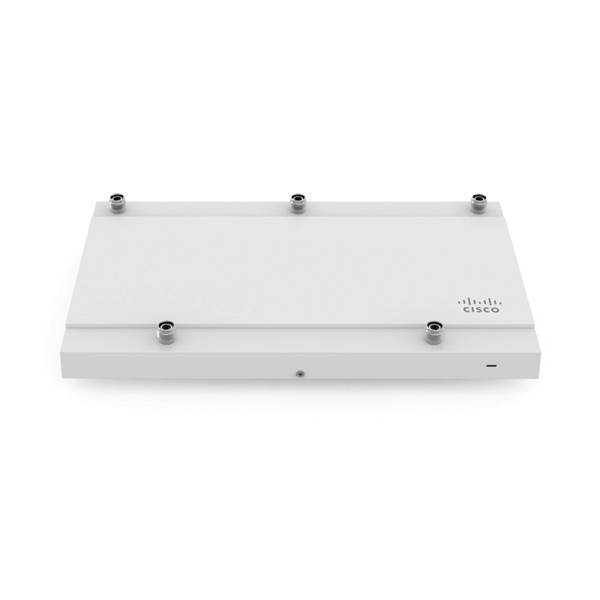
The Cisco Meraki MR42E is a cloud-managed 802.11ac Wave 2 access point designed for general-purpose wireless LANs and deployments requiring flexible coverage in complex RF environments. With support for auto-detectable external antennas and powerful cloud-based tools, it delivers scalable performance and robust security.
Ideal Use Cases
- General-purpose enterprise Wi-Fi
- Challenging RF environments
- Locations needing directional/focused coverage
Key Hardware Features
- Four integrated radios: 2.4 GHz, 5 GHz, WIDS/WIPS, and BLE
- 3×3 MU-MIMO 802.11ac Wave 2, up to 1.9 Gbps aggregate throughput
- Five RP-TNC connectors for external antennas
- One Gigabit Ethernet port
- PoE compliant (802.3at; also compatible with 802.3af)
- Optional AC power adapter
Cloud Management Capabilities
- End-to-end visibility and centralized control across all networks
- Integrated analytics, real-time anomaly detection, and historical reporting
- Zero-touch provisioning for rapid deployment
- Seamless cloud firmware updates
- Built-in redundancy and secure architecture
Analytics and Visibility
- Visitor analytics: capture rate, duration, repeat visits
- AP event tracking across radios in real-time and historical views
- Global Layer 7 traffic insights by app, device, and network
Enterprise-Grade Security
- 802.1X authentication and Active Directory support
- Air Marshal: real-time WIPS with forensic capabilities
- Stateful Layer 3–7 firewall
- Identity-based policies and NAC-integrated antivirus scanning
Guest Access Features
- One-click guest onboarding with customizable splash pages
- Guest traffic isolation
- Social media login options (Facebook, Google)
- Cisco ISE integration for guest access and BYOD
RF Optimization
- Dual-concurrent radios with MU-MIMO performance
- Third radio dedicated to RF and security monitoring
- Real-time spectrum analysis
- Cloud-driven automatic RF tuning
Layer 7 Traffic Management
- Application-aware bandwidth shaping
- App-level QoS and throttling
- Restriction of non-essential traffic
Device Management
- Device-specific firewall configurations
- Inventory tracking and app deployment
- Security enforcement via EMM/MDM integrations