Description
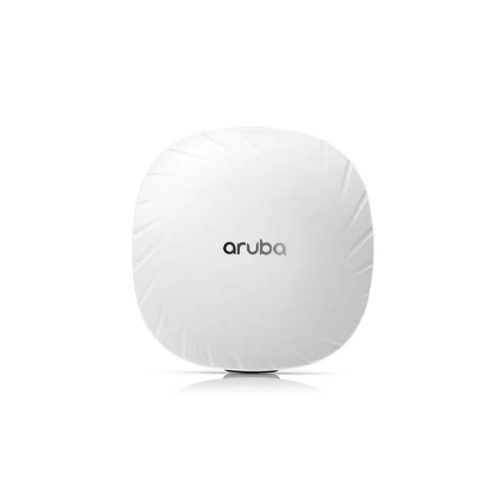
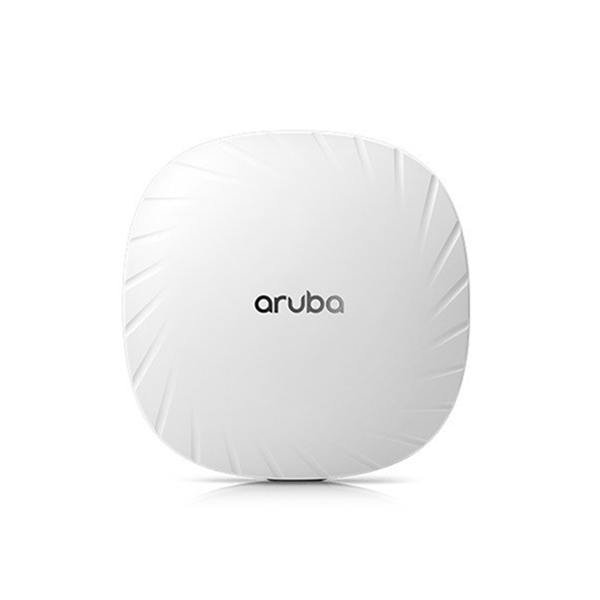
The 510 series is designed to simultaneously serve multiple clients and traffic types in dense environments, and boosts overall network performance by up to 4X compared to 802.11ac APs.
In addition to the benefits of 802.11ax, the 510 series delivers differentiated capabilities such as AI-powered Wi-Fi performance assurance, always-on connectivity, and WPA3 certified security. Green AP mode offers AI-driven energy savings of up to 70%.
Hardware Variants
- AP-514: External antenna model
- AP-515: Internal antenna model
Wi-Fi Radio Specifications
- AP Type: Indoor, dual radio, 5GHz 802.11ax 4×4 MIMO and 2.4GHz 802.11ax 2×2 MIMO
- 5GHz Radio:
- 4SS SU-MIMO: Up to 4.8Gbps to individual 4SS HE160 client devices (max)
- 2SS SU-MIMO: Up to 1.2Gbps to individual 2SS HE80 client devices (typical)
- 4SS MU-MIMO: Up to 4.8Gbps to four 1SS or two 2SS HE160 DL-MU-MIMO clients (max)
- 4SS MU-MIMO: Up to 2.4Gbps to four 1SS or two 2SS HE80 DL-MU-MIMO clients (typical)
- 2.4GHz Radio:
- 2SS SU-MIMO: Up to 575Mbps to 2SS HE40 clients or two 1SS HE40 MU-MIMO clients (max)
- 2SS SU-MIMO: Up to 287Mbps to 2SS HE20 clients or two 1SS HE20 MU-MIMO clients (typical)
- Supports up to 256 associated clients per radio and up to 16 BSSIDs per radio
- Supported Frequency Bands:
- 2.400 to 2.4835GHz
- 5.150 to 5.250GHz
- 5.250 to 5.350GHz
- 5.470 to 5.725GHz
- 5.725 to 5.850GHz
- Available channels dependent on regulatory domain
- Dynamic Frequency Selection (DFS) for RF spectrum optimization
Supported Radio Technologies
- 802.11b: DSSS
- 802.11a/g/n/ac: OFDM
- 802.11ax: OFDMA (up to 16 resource units on 80MHz)
Modulation Types
- 802.11b: BPSK, QPSK, CCK
- 802.11a/g/n: BPSK, QPSK, 16-QAM, 64-QAM, 256-QAM
- 802.11ac: BPSK to 1024-QAM
- 802.11ax: BPSK to 1024-QAM
High Throughput Support
- 802.11n: HT20/40
- 802.11ac: VHT20/40/80/160
- 802.11ax: HE20/40/80/160
Supported Data Rates (Mbps)
- 802.11b: 1, 2, 5.5, 11
- 802.11a/g: 6, 9, 12, 18, 24, 36, 48, 54
- 802.11n (2.4GHz): 6.5 to 300 (MCS0–15, HT20/40)
- 802.11n (5GHz): 6.5 to 600 (MCS0–31, HT20/40)
- 802.11ac: 6.5 to 3467 (MCS0–9, NSS 1–4, VHT20–160)
- 802.11ax (2.4GHz): 3.6 to 574 (MCS0–11, NSS 1–2, HE20–40)
- 802.11ax (5GHz): 3.6 to 4803 (MCS0–11, NSS 1–4, HE20–160)
Advanced Features
- Packet aggregation: A-MPDU, A-MSDU
- Transmit power: Configurable in 0.5 dBm increments
- Max conducted transmit power:
- 2.4GHz: +21 dBm (18 dBm/chain)
- 5GHz: +24 dBm (18 dBm/chain)
- Note: Antenna gain not included in conducted power values
- ACC (Advanced Cellular Coexistence) for reduced interference
- Maximum Ratio Combining (MRC)
- Cyclic Delay/Shift Diversity (CDD/CSD)
- Space-Time Block Coding (STBC)
- Low-Density Parity Check (LDPC)
- Transmit Beamforming (TxBF)
- 802.11ax Target Wait Time (TWT) for low-power clients
Wi-Fi Antennas
- AP-514:
- Four RP-SMA connectors for external dual-band antennas (A0–A3)
- Worst-case internal loss: 1.3dB (2.4GHz), 1.7dB (5GHz)
- AP-515:
- Four integrated dual-band downtilt omnidirectional antennas
- Peak gain: 4.2dBi (2.4GHz), 7.5dBi (5GHz)
- Optimized for horizontal ceiling mount; downtilt angle ~30°
- Effective per-antenna peak gain: 3.8dBi (2.4GHz), 4.6dBi (5GHz)